
Affiliate Disclosure: Some links on CB Profits Work may be affiliate links. If you purchase through one of these links, I may earn a commission at no additional cost to you. I only recommend tools, products, and resources that I believe may be useful to readers.
Free vs paid affiliate traffic is one of the first decisions beginners face when trying to attract visitors to their content, landing pages, and affiliate offers.
Free traffic sounds attractive because you don’t pay for every visitor. Paid traffic sounds attractive because you may be able to reach an audience much faster.
But neither option is automatically better.
Free traffic requires an investment of time, content, consistency, and patience. Paid traffic requires money, testing, tracking, and the discipline to stop campaigns that aren’t producing useful results.
Understanding free vs paid affiliate traffic can help you choose a strategy that fits your experience, budget, audience, and overall affiliate marketing system.
Let’s compare the two approaches across seven important differences.
What Is Free Affiliate Traffic?
Free traffic generally refers to visitors you attract without paying directly for each click, impression, or visitor.
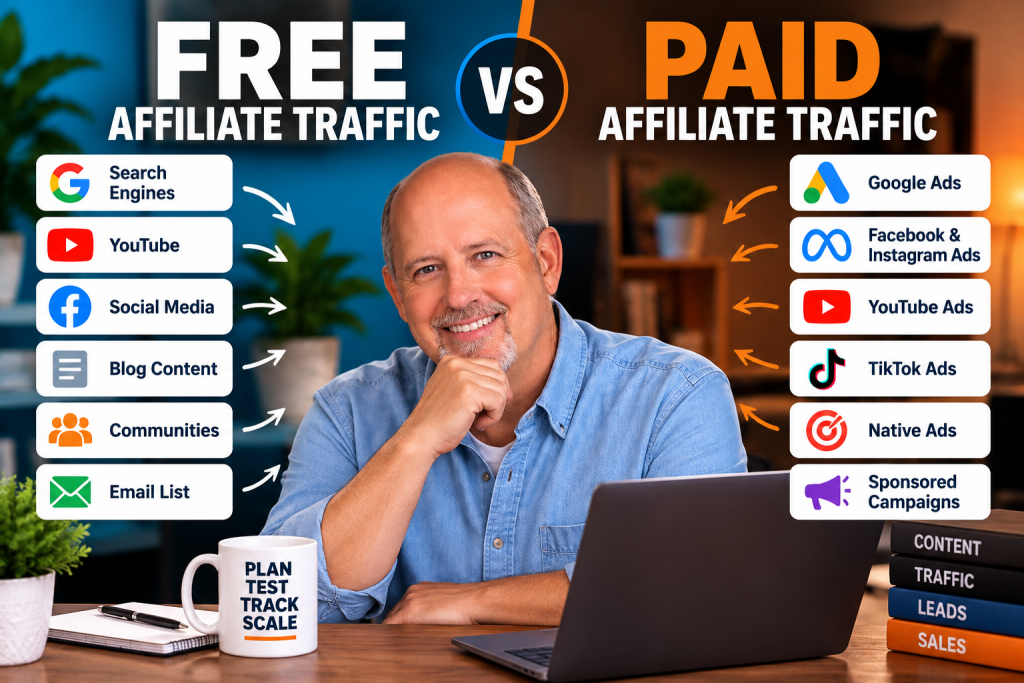
Common sources of free or organic affiliate traffic include:
- Search engine traffic
- Blog content
- YouTube videos
- Organic Facebook content
- TikTok and other social platforms
- Online communities
- Email subscribers you’ve already acquired
- Referrals and recommendations
The word free can be misleading, though. You may not pay for every visitor, but creating content and building an audience takes time and resources.
That’s why organic traffic is often better thought of as earned traffic rather than traffic that costs nothing.
What Is Paid Affiliate Traffic?
Paid traffic is generated by spending money to place advertisements or sponsored content in front of an audience.
Examples can include:
- Google Ads
- Facebook and Instagram advertising
- YouTube advertising
- TikTok advertising
- Native advertising
- Sponsored placements
- Other pay-per-click or pay-per-impression campaigns
Paid traffic can potentially generate visitors much faster than waiting for content to rank or an audience to grow organically.
But speed doesn’t automatically mean profitability. You’re paying to test whether the audience, message, landing page, and offer work together.
Free vs Paid Affiliate Traffic: 7 Key Differences
When comparing free vs paid affiliate traffic, don’t look only at the price of a click. Consider the cost, speed, control, testing opportunities, risk, and long-term value of each strategy.
1. Cost: Money vs Time
The most obvious difference is how you pay for the traffic.
With organic methods, your primary investment may be the time required to research topics, create content, optimize pages, publish videos, engage with an audience, and build authority.
Paid traffic shifts more of that investment toward money. You establish a budget and pay the advertising platform according to the type of campaign you’re running.
Neither method is truly free. The question is whether you’re primarily investing time, money, or some combination of both.
2. Speed: Paid Traffic Can Start Faster
Organic traffic often takes time to develop.
A new article may take time to appear in search results. A new social account may initially have a small audience. A YouTube channel may need a library of useful videos before it develops consistent viewership.
Paid campaigns can begin generating impressions and clicks shortly after they’re approved.
That makes paid traffic useful for testing, but it also means you can spend money quickly when something isn’t working.
Speed is valuable only when you know what you’re measuring.
3. Control: Paid Traffic Offers More Targeting Options
Paid advertising typically gives marketers more direct control over who may see a campaign, depending on the platform and the targeting options it provides.
Organic distribution is less predictable. Search engines and social platforms determine how and when content appears based on their own systems.
But targeting tools can’t rescue a poorly defined audience.
Before buying traffic, make sure you understand how to find the right target audience for affiliate marketing. The better you understand the person you’re trying to reach, the better decisions you can make with either traffic method.
4. Testing: Paid Traffic Can Produce Data Faster
Another difference between free vs paid affiliate traffic is how quickly you may be able to gather useful testing data.
Paid traffic can allow you to test a message or page without waiting months for substantial organic traffic.
You might test:
- Different headlines
- Landing-page offers
- Lead magnets
- Calls to action
- Audience segments
- Ad creatives
But testing requires tracking. Otherwise, you’re spending money without learning much from the result.
Google Analytics supports campaign parameters that can help identify traffic according to source, medium, and campaign. Google’s documentation explains how to collect campaign data with custom URLs.
That information can help you compare traffic sources instead of treating every visitor as though they arrived the same way.
5. Risk: Paid Traffic Can Lose Money Quickly
This is where beginners need to be careful.
A campaign can generate plenty of clicks without generating enough leads or affiliate sales to justify its cost.
If you’re getting clicks but not sales, buying additional traffic may simply increase the amount you’re losing.
Before increasing a campaign budget, read Why Am I Getting Affiliate Clicks but No Sales? 7 Things to Check Before You Buy More Traffic.
We’ve also identified 5 things to fix before you buy more affiliate traffic.
The lesson is simple: don’t use additional traffic to avoid fixing a conversion problem.
6. Long-Term Value: Organic Content Can Become an Asset
One of the strongest arguments for organic traffic is that useful content can continue attracting visitors after the initial work is finished.
A helpful blog article, tutorial, comparison, or video may continue being discovered long after publication.
Advertising works differently. When you stop paying for a campaign, the paid flow of traffic generally stops with it.
That doesn’t make paid traffic bad. It simply means the two approaches create different types of value.
Organic content can become part of your business’s long-term content library. Paid traffic can help you acquire visitors and data more quickly.
7. Conversion: Both Need a Working Funnel
This may be the most important difference that isn’t actually a difference.
Whether a visitor comes from free traffic or paid traffic, something useful needs to happen after the click.
A basic affiliate marketing funnel can connect traffic to a landing page, email list, helpful content, and relevant affiliate offers.
Your affiliate marketing landing page also needs to give visitors a clear reason to take the next step.
Traffic doesn’t repair a weak funnel. It exposes it.
Should Beginners Start With Free or Paid Traffic?
For many beginners, starting with organic traffic can provide valuable experience before risking significant money on advertising.
Creating content forces you to learn your audience, understand their questions, improve your messaging, and evaluate which topics generate interest.
That doesn’t mean beginners should never use paid traffic.
A controlled test with a predetermined budget can be useful when you understand what you’re testing and can afford to lose the testing budget without affecting essential expenses.
The mistake is treating paid traffic like a vending machine where every dollar automatically returns more than a dollar.
A Hybrid Free vs Paid Affiliate Traffic Strategy
Choosing between free vs paid affiliate traffic doesn’t have to be permanent. As your affiliate business develops, a combination of organic and paid traffic may make sense.
For example, you might create useful organic content that attracts visitors over time while using a limited paid campaign to test a lead magnet or landing page.
If the data shows that a particular page or message resonates with visitors, you have better information for deciding whether to expand the campaign.
Meanwhile, your organic content continues building a library that isn’t entirely dependent on advertising spend.
Don’t Send Every Visitor Directly to an Affiliate Offer
Another reason funnels matter is that affiliate programs and advertising platforms can change.
Instead of building your entire business around sending strangers directly from an advertisement to somebody else’s sales page, consider building assets you control along the way.
One of those assets is your email list.
Our guide on how to build an email list for affiliate marketing explains how beginners can begin creating that connection with their audience.
An email subscriber gives you an opportunity to provide additional value rather than depending on one visitor making one immediate purchase.
Free vs Paid Affiliate Traffic Requires the Same Foundation
Another useful way to compare free vs paid affiliate traffic is to look at what both strategies require before they can work well.
You still need an audience you understand. You still need useful content or messaging. You still need a destination for the traffic. You still need an appropriate offer. And you still need a way to determine whether the visitor took the action you wanted.
Traffic is only one part of the system.
That’s why beginners should resist the temptation to spend all their energy hunting for a secret traffic source. Improving the foundation often matters more than discovering another place to get clicks.
Track the Numbers That Actually Matter
Regardless of which traffic strategy you use, don’t measure success only by the number of visitors.
Depending on your funnel, useful measurements may include:
- Visitors
- Cost per click
- Landing-page conversion rate
- Cost per lead
- Email opt-ins
- Affiliate-link clicks
- Sales
- Revenue
- Advertising cost
A traffic source that sends fewer visitors but produces more qualified leads may be more valuable than a source generating large numbers of visitors who immediately leave.
Advertising platforms also have their own rules about claims, targeting, and prohibited content. Before launching paid campaigns, review the policies for the platform you’re using. For example, Google publishes its advertising policies and requirements for advertisers.
And when affiliate relationships are involved, transparency still matters. The Federal Trade Commission’s endorsement guidance explains disclosure responsibilities involving material connections and affiliate relationships.
The CB Profits Work Takeaway
There isn’t a universal winner when comparing free vs paid affiliate traffic.
Organic traffic can help you build content assets and learn your audience without paying for every visitor. Paid traffic can provide speed, targeting, and faster testing, but it introduces financial risk and requires disciplined tracking.
Beginners don’t need every traffic source.
They need a traffic source they understand, a useful destination for the visitor, and a way to measure what happens next.
Learn first. Test carefully. Track the results. Then scale what actually works.
Free: Affiliate Marketing Foundation Checklist
Before spending more time or money trying to generate traffic, make sure the foundation of your affiliate marketing business is in place.
The free CB Profits Work 40-Point Affiliate Marketing Foundation Checklist gives you a practical way to review the essential pieces of your affiliate business and identify what may need attention next.
→ Get the Free 40-Point Affiliate Marketing Foundation Checklist