

Affiliate Disclosure: Some links on CB Profits Work may be affiliate links. If you purchase through one of these links, I may earn a commission at no additional cost to you. I only recommend tools, products, and resources that I believe may be useful to readers.
An affiliate marketing landing page has one important job: help the right visitor take the next logical step.
That step might be joining your email list, downloading a free checklist, requesting a guide, registering for training, or learning more about a product you recommend.
For beginners, the temptation is to put everything on one page. Multiple offers, several buttons, a long menu, social links, banners, affiliate products and anything else that might generate a click.
Usually, simpler is better.
A good landing page gives visitors a clear reason to stay, explains what they will receive, builds enough trust to continue, and makes the next action obvious.
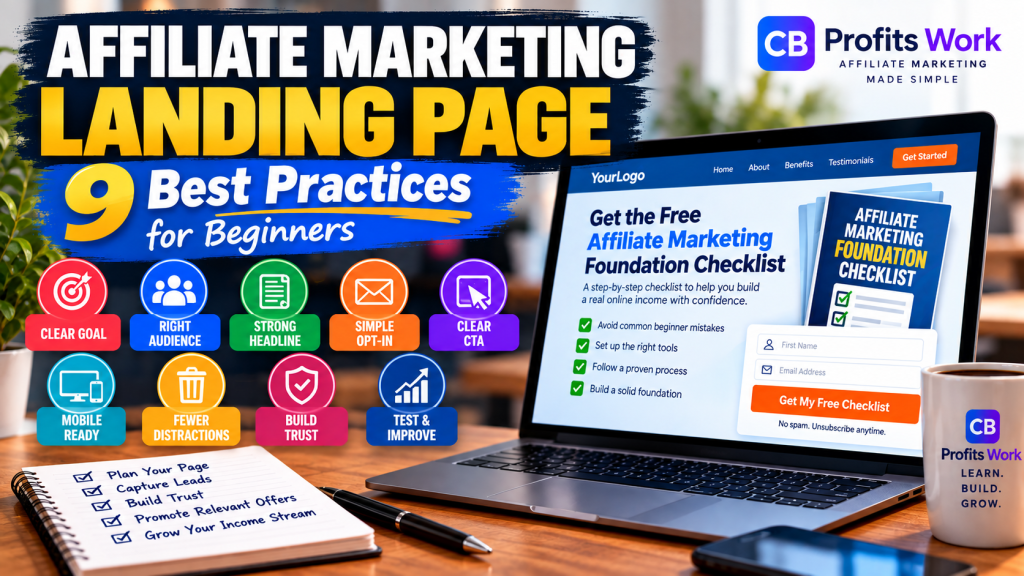
Here are nine practical best practices you can use when building your first affiliate marketing landing page.
What Is an Affiliate Marketing Landing Page?
An affiliate marketing landing page is a focused web page created for visitors arriving from a particular piece of content, advertisement, email, social post, search result, or other traffic source.
Unlike a traditional website homepage, a landing page normally has one primary objective.
For an affiliate marketer, that objective could be:
- Capturing an email address
- Delivering a lead magnet
- Introducing a product or service
- Sending someone to useful bridge content
- Registering a visitor for a webinar or training
- Helping a visitor decide whether to investigate an affiliate offer
The landing page is also an important part of the larger system we explained in Affiliate Marketing Funnel: 5 Simple Steps for Beginners.
Instead of sending every visitor directly to an affiliate sales page, you can use your own content and landing pages to create a more useful path between traffic and the products you recommend.
1. Give Your Landing Page One Primary Goal
Before choosing a template, writing a headline, or changing button colors, decide exactly what you want the visitor to do.
One page with five competing goals forces the visitor to decide where to go. A focused page makes that decision easier.
If your goal is building an email list, the primary action should be joining that list. If the goal is getting someone to read a product review, make that the obvious next step.
This doesn’t mean an affiliate marketing landing page can contain only one link. It means the page should have one dominant objective and the important elements should support that objective.
2. Match the Page to the Right Audience
A beautifully designed page can still perform poorly if it speaks to the wrong people.
Your headline, benefits, examples and offer should make sense to the visitor who arrives on the page.
Suppose you’re helping beginners learn affiliate marketing. A landing page filled with advanced media-buying terminology and enterprise analytics probably isn’t the best introduction.
Start with the person you’re trying to help. If you haven’t clearly defined that person yet, read our guide on how to find the right target audience for affiliate marketing.
The better your page matches the visitor’s problem and level of experience, the easier it becomes to communicate why the next step matters.
3. Write a Clear Headline Before a Clever One
Your headline is one of the first things a visitor sees.
Don’t make people solve a riddle to understand your offer.
A useful headline should quickly communicate what the page is about or what the visitor can receive.
For example:
Get the Free 40-Point Affiliate Marketing Foundation Checklist
That isn’t flashy. It is clear.
A supporting subheadline can then explain who the resource is for or what problem it helps address.
Clarity is especially important on an affiliate marketing landing page because many visitors will decide within a short period whether the page appears relevant to them.
4. Explain the Benefit of Taking the Next Step
Visitors don’t need a long list of features before they understand why they should care.
If you’re offering a checklist, don’t stop at telling them it contains 40 items. Explain how the checklist can help them organize the foundation of their affiliate marketing business.
If you’re offering a guide, explain what the reader should understand after reading it.
Useful benefits are specific and believable.
- Know what to set up first
- Identify missing pieces in your affiliate system
- Organize your next steps
- Avoid common beginner mistakes
Avoid turning benefits into exaggerated promises. Your landing page should create enough interest for someone to continue—not promise results you cannot guarantee.
5. Keep the Opt-In Form Simple
If the purpose of your affiliate marketing landing page is lead generation, ask only for information you actually need.
For many beginner funnels, a first name and email address may be enough. In some cases, only the email address is necessary.
Every additional field creates another decision for the visitor.
Once someone subscribes, your email system gives you an opportunity to continue the conversation with useful information rather than trying to explain everything on a single page.
If you’re still setting up this part of your system, our guide on how to build an email list for affiliate marketing explains the basic pieces beginners need.
6. Use One Clear Call to Action
Your call to action tells visitors what happens next.
Generic button text such as Submit may technically work, but more descriptive language often provides better context.
Depending on the page, examples could include:
- Get the Free Checklist
- Download the Guide
- Start the Free Training
- See How It Works
- Read the Full Review
The important thing is consistency. If your headline promises a checklist, your button shouldn’t suddenly tell the visitor to “Buy Now.”
The headline, copy and call to action on your affiliate marketing landing page should all point toward the same next step.
7. Remove Unnecessary Distractions
Landing pages are different from ordinary website pages.
Your blog may need navigation menus, categories, recent posts and other ways for visitors to explore. A dedicated landing page often benefits from fewer choices.
Review every element and ask a simple question:
Does this help the visitor understand or complete the primary action?
If it doesn’t, consider whether it needs to be there.
That includes unnecessary navigation, unrelated advertisements, multiple competing affiliate offers, excessive pop-ups and links that send visitors away from the page without a good reason.
8. Make Sure the Landing Page Works on Mobile
Don’t build your page on a desktop monitor and assume it works everywhere else.
Check the mobile version yourself.
- Can you read the headline without zooming?
- Does the page load properly?
- Is the form easy to complete?
- Can you clearly see and tap the call-to-action button?
- Do images fit the screen?
- Are paragraphs comfortable to read?
Google recommends responsive web design as one way of serving the same HTML across devices while adapting the display to the visitor’s screen size. You can review Google’s mobile-first indexing and mobile site guidance when evaluating the technical side of your pages.
A mobile visitor should receive the same clear experience as someone viewing your affiliate marketing landing page on a desktop computer.
9. Test the Page Before Buying More Traffic
Before paying for more visitors, make sure the page itself works.
Submit the form yourself. Confirm the email arrives. Click the button. Check the thank-you page. Test the links. View the page on your phone.
Then watch what actual visitors do.
Useful measurements can include:
- Landing page visits
- Opt-ins
- Conversion rate
- Button clicks
- Traffic source
- Affiliate-link clicks
Google Analytics also supports campaign URL parameters that can help distinguish traffic by source, medium and campaign. Google’s documentation explains how to collect campaign data with custom URLs.
If people are reaching the page but almost nobody takes the desired action, increasing traffic may simply magnify the problem. That’s why we recommend reviewing these 5 things to fix before you buy more affiliate traffic before increasing your ad spend.
Your Affiliate Marketing Landing Page Should Build Trust
Conversion matters, but trust matters too.
Don’t use fake countdown timers, fabricated testimonials, misleading scarcity, hidden costs, or promises of guaranteed income simply to increase clicks.
If your page includes affiliate recommendations, make the relationship clear. The Federal Trade Commission’s Endorsement Guides guidance explains the importance of clearly and conspicuously disclosing material relationships between endorsers and marketers.
Your affiliate marketing landing page should help visitors understand what you’re offering and what happens next without making them hunt for important information.
The CB Profits Work Takeaway
You don’t need an elaborate page to get started.
A strong affiliate marketing landing page starts with the right audience, one clear objective, a straightforward headline, believable benefits, a simple call to action and a page that works properly on both desktop and mobile devices.
Then you measure what happens and improve the page based on evidence rather than guesses.
Clear beats clever. Useful beats flashy. And trust is worth more than a short-term click.
Free: Affiliate Marketing Foundation Checklist
Before adding more tools, traffic or offers to your affiliate marketing business, make sure the fundamentals are in place.
The free CB Profits Work 40-Point Affiliate Marketing Foundation Checklist gives you a practical way to review the foundation of your business and identify what may need attention next.
→ Get the Free 40-Point Affiliate Marketing Foundation Checklist