

Affiliate Disclosure: Some links on CB Profits Work are affiliate links. If you purchase through one of these links, I may earn a commission at no additional cost to you. I only recommend tools, products, and resources that I believe may be useful to readers.
Is your affiliate landing page not converting even though you’re getting visitors?
That can be frustrating, especially when you’ve already put time into building the page, choosing an affiliate offer, and generating traffic.
But a landing page that isn’t producing results doesn’t automatically mean affiliate marketing isn’t working. It usually means something in the path between the visitor’s first click and your desired action needs attention.
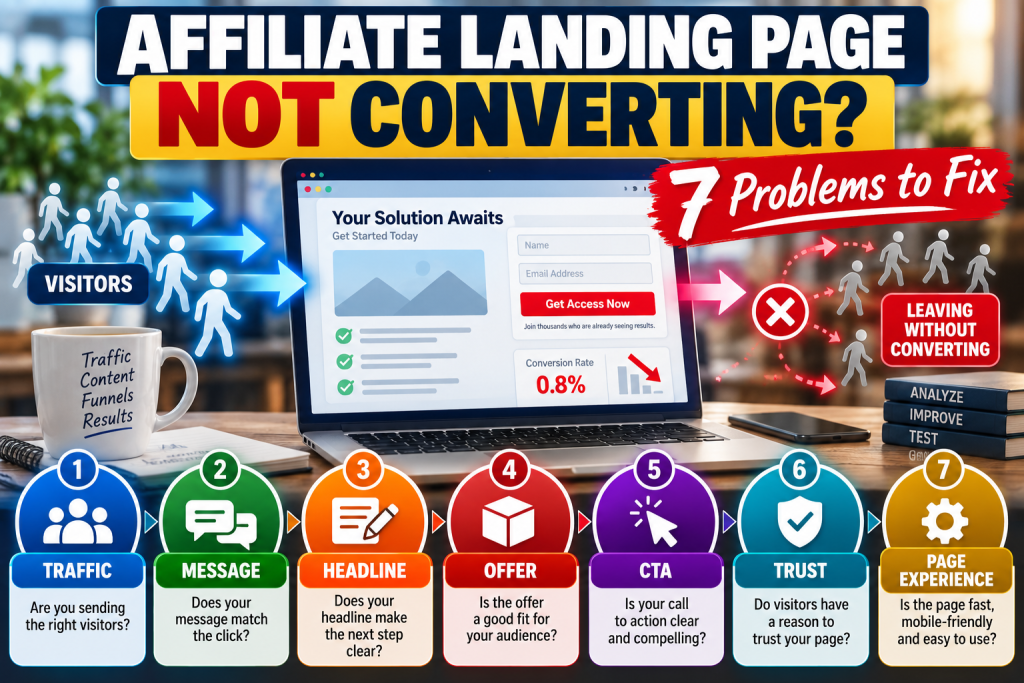
The problem could be the traffic, the message, the headline, the offer, the call to action, a lack of trust, or even the page experience itself.
If your affiliate landing page not converting is the problem you’re trying to solve, don’t immediately rebuild everything. Start by checking these seven areas one at a time.
Affiliate Landing Page Not Converting? Check These 7 Problems
1. You’re Sending the Wrong Traffic to the Page
A landing page can’t fix a traffic problem.
You could have a clear headline, attractive design, strong call to action, and relevant offer—but if the people arriving aren’t interested in the problem you’re addressing, conversions can still be weak.
Before changing the page, ask where your visitors are coming from and what they expected when they clicked.
- What search term, advertisement, post, or email brought them there?
- Does that traffic source reach the audience the offer was designed for?
- Did your promotion promise something different from what the landing page delivers?
- Are visitors looking for information, or are they ready to consider a solution?
If your affiliate landing page not converting problem begins with poorly matched traffic, changing button colors probably isn’t going to solve it.
Start with our guide on how to find the right target audience for affiliate marketing. If you’re buying visitors, also review 5 things to fix before you buy more affiliate traffic before increasing your budget.
2. The Message Doesn’t Match the Click
Visitors arrive with an expectation.
If an ad promises a beginner’s guide but the landing page immediately pushes a product, the visitor may feel like they’ve landed in the wrong place.
The same problem can happen when a social post discusses one benefit while the landing page emphasizes something completely different.
This is often called message match: the idea that the message that earns the click should connect naturally with the message the visitor sees after clicking.
Check your traffic source and landing page side by side.
The wording doesn’t need to be identical, but the visitor should immediately understand that the page continues the conversation they started before the click.
When an affiliate landing page not converting has a message-match problem, improving that continuity may matter more than redesigning the entire page.
3. Your Headline Doesn’t Make the Next Step Clear
Your headline has an important job.
It should quickly help visitors understand why they’re on the page and why they should keep reading.
A headline doesn’t need to be clever. In many cases, clarity is more useful than creativity.
Ask whether your headline communicates:
- Who the page is for
- What problem or goal it addresses
- What the visitor can expect next
Compare a vague headline such as:
“Change Your Life Today!”
with something more specific:
“A Beginner’s Checklist for Building Your Affiliate Marketing Foundation.”
The second version doesn’t guarantee a result. It simply tells the visitor what the resource is and who it’s designed to help.
If your affiliate landing page not converting issue starts above the fold, make clarity the first thing you test.
4. The Offer Doesn’t Fit the Visitor
Sometimes the landing page isn’t the real problem.
The offer may simply be a poor fit for the audience.
This is especially important in affiliate marketing because you usually don’t control the product, checkout process, pricing, or vendor sales page.
You do control which offers you choose to promote.
Before blaming your landing page, ask:
- Does the product address the problem that brought the visitor here?
- Is the offer appropriate for the visitor’s level of awareness?
- Does the vendor explain what the customer receives?
- Are the claims reasonable?
- Is the price appropriate for the audience you’re attracting?
- Would you feel comfortable recommending the offer to someone you know?
Our guide on how to choose ClickBank products covers nine checks beginners can make before promoting an offer.
A better landing page cannot turn the wrong offer into the right one.
5. Your Call to Action Is Confusing
What exactly do you want the visitor to do?
Download a checklist? Enter an email address? Read a review? Watch a video? Visit the affiliate offer?
If the visitor has to figure out the next step, the page is creating unnecessary friction.
A useful call to action should be visible, understandable, and connected to the promise of the page.
Instead of a generic button such as Submit, a specific call to action might say:
- Get the Free Checklist
- Read the Full Review
- See What’s Included
- Continue to the Training
That doesn’t mean filling the page with buttons. More calls to action don’t automatically create more conversions.
If your affiliate landing page not converting has several competing actions, simplify the page and make the primary next step obvious.
For a broader look at landing-page structure, see our affiliate marketing landing page guide.
6. Visitors Don’t Have Enough Reason to Trust the Page
Trust matters online, particularly when you’re asking someone to provide an email address, click through to another website, or consider buying something.
Trust isn’t created by simply adding the word “trusted” to a page.
It develops through the overall experience.
- Is it clear who operates the website?
- Can visitors find basic contact or about information?
- Are affiliate relationships disclosed?
- Does the page avoid exaggerated promises?
- Is the writing useful and understandable?
- Do the links work?
- Does the page look maintained?
For affiliate marketers, transparency is part of that trust. Our affiliate marketing disclosure guide explains seven disclosure principles beginners should know.
The Federal Trade Commission also provides guidance concerning endorsements and material connections. You can review the FTC’s endorsement guidance for additional information.
7. The Page Experience Is Creating Friction
A landing page can have the right message and still make it difficult for visitors to take action.
Check the practical experience of using the page.
- Does it load reasonably quickly?
- Is it easy to use on a phone?
- Can visitors read the text without zooming?
- Are buttons easy to tap?
- Do forms work?
- Are pop-ups blocking important content?
- Do all links go to the correct destination?
Don’t test only from the desktop computer you used to build the page. Open it on your phone and experience it the way a visitor would.
Google’s PageSpeed Insights can also help identify performance and user-experience issues worth investigating.
If your affiliate landing page not converting also has slow loading, broken forms, or poor mobile usability, fix those issues before drawing conclusions about the offer itself.
Don’t Guess Why Your Affiliate Landing Page Is Not Converting
One of the biggest mistakes you can make is changing several things at once without knowing where the problem occurs.
Suppose you replace the headline, change the offer, redesign the page, change the call to action, and start buying traffic from a different source on the same day.
Conversions improve.
Great—but what actually fixed the problem?
You don’t know.
Instead, establish basic tracking and make deliberate changes whenever possible.
Our guide on how to track affiliate links explains seven metrics beginners can use to better understand campaign performance.
Look at the Entire Affiliate Funnel
A landing page is only one part of the customer journey.
A simple path might look like this:
Traffic → Content or Ad → Landing Page → Email or Bridge Content → Affiliate Offer → Conversion
If the landing page gets blamed for every weak result, you may overlook problems elsewhere in that sequence.
For example, the landing page might successfully collect leads while the follow-up emails produce very few clicks. Or visitors may click through from your landing page, but the affiliate offer itself converts poorly.
That’s why diagnosing an affiliate landing page not converting should include the entire path—not just the page design.
Our affiliate marketing funnel guide explains how those pieces can work together.
Ready to Put the Pieces Together?
Fixing a landing page is useful, but the larger challenge is understanding how traffic, content, landing pages, email, affiliate offers, and tracking work together.
That’s one reason I joined the ClickBank Profit Club. I wanted additional training, tools, and guidance that could help me continue developing my own affiliate marketing business as a connected system rather than a collection of unrelated tactics.
No training program can guarantee that your landing pages will convert or that you’ll earn affiliate income. You’ll still need to learn, implement, test, measure, and make your own decisions.
But if you’re at the point where individual pieces of affiliate marketing are beginning to make sense and you want additional help putting those pieces together, it’s an option worth investigating.
→ Take a Look at the ClickBank Profit Club
Review what’s included and decide whether the training fits where you are in your own affiliate marketing journey.
The CB Profits Work Takeaway
If your affiliate landing page not converting is frustrating you, don’t assume you need a prettier page or more traffic.
Work through the fundamentals first.
- Check the quality and intent of your traffic.
- Make sure the message matches the original click.
- Clarify the headline.
- Evaluate the offer.
- Simplify the call to action.
- Strengthen trust.
- Remove technical and mobile friction.
Then track what happens and improve the weak point instead of changing everything at once.
Good affiliate marketing isn’t about guessing what might work. It’s about building a sensible process, measuring what happens, and improving it one piece at a time.
Want to Check Your Affiliate Marketing Foundation First?
If you’re not ready for additional training, start with the fundamentals.
The free CB Profits Work 40-Point Affiliate Marketing Foundation Checklist can help you review the core pieces of your affiliate marketing business, including your audience, content, traffic, offers, tracking, disclosures, and overall foundation.
→ Get the Free 40-Point Affiliate Marketing Foundation Checklist