
Affiliate Disclosure: Some links on CB Profits Work may be affiliate links. If you purchase through one of these links, I may earn a commission at no additional cost to you. I only recommend tools, products, and resources that I believe may be useful to readers.
An affiliate marketing funnel gives your traffic somewhere to go besides directly to a sales page.
Instead of finding a product, grabbing an affiliate link, and hoping somebody buys, a funnel creates a simple path that helps the right people discover your content, learn from you, join your email list, and eventually consider a relevant offer.
For beginners, that distinction matters. More traffic alone doesn’t necessarily fix an affiliate marketing business. You also need a process for turning some of that traffic into an audience you can continue helping.
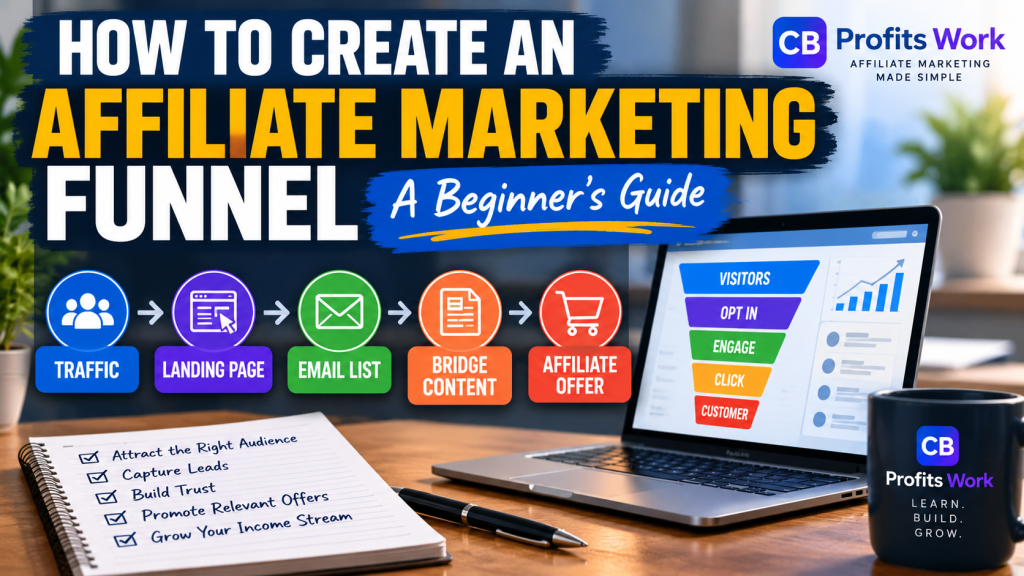
The good news is that your first funnel does not need to be complicated. In this guide, we’ll walk through a practical five-part structure:
- Traffic
- Landing page
- Email list
- Bridge content
- Affiliate offer
What Is an Affiliate Marketing Funnel?
An affiliate marketing funnel is a series of steps designed to move someone from discovering your content to learning more about a product or service that may solve a problem for them.
Think of it as a pathway rather than a single link.
A visitor might first discover one of your blog posts through Google, Facebook, YouTube, an email, or another traffic source. That visitor can then reach a landing page, request a useful resource, receive follow-up information, and eventually encounter an affiliate recommendation that makes sense for what they are trying to accomplish.
A basic funnel might look like this:
Traffic → Landing Page → Email List → Bridge Content → Affiliate Offer
Each part has a job. When those jobs work together, you’re no longer relying entirely on one click producing one immediate sale.
Step 1: Start With the Right Traffic
Every funnel starts with people.
But one of the most common beginner mistakes is assuming that more visitors automatically means more affiliate sales. It doesn’t.
The goal is to attract people whose interests and problems match the content and offers in your funnel.
Before worrying about traffic volume, understand how to find the right target audience for affiliate marketing. Knowing who you’re trying to reach makes everything that follows easier—from choosing topics to writing emails and selecting products.
Your traffic might eventually come from several sources, including:
- Search engines
- Facebook or other social platforms
- YouTube
- Email marketing
- Paid advertising
- Online communities
- Referral traffic
You don’t need all of them at once. Beginners are usually better served by learning one or two traffic methods well before spreading themselves across every available platform.
And before spending additional money on advertising, review these 5 things to fix before you buy more affiliate traffic.
Step 2: Create a Simple Landing Page
The next part of your affiliate marketing funnel is the landing page.
A landing page should have one primary purpose. For a beginner funnel, that purpose is often getting an interested visitor to join your email list in exchange for something useful.
That resource might be a checklist, short guide, template, mini-course, resource list, or another practical tool connected to the problem your audience is trying to solve.
Keep the page focused. A basic opt-in landing page usually needs:
- A clear headline
- A brief explanation of what the visitor will receive
- A few specific benefits
- An email opt-in form
- A clear call to action
You don’t need ten menus, six different offers, flashing countdown timers, or a page packed with distractions. The visitor should immediately understand what you’re offering and what to do next.
Step 3: Build an Email List You Control
This is where the funnel becomes more valuable than simply sending every visitor directly to an affiliate offer.
If someone clicks your affiliate link and leaves, you may never have another opportunity to communicate with that person.
If that person voluntarily joins your email list, however, you can continue providing useful information, answering common questions, introducing new resources, and building a relationship over time.
We’ve created a separate beginner guide explaining how to build an email list for affiliate marketing, including the basic pieces you need to get started.
Your email list should not become a nonstop stream of promotions. Give subscribers a reason to keep opening your messages.
Teach something. Answer a question. Share a useful resource. Explain a mistake. Help them make a better decision.
Then, when an affiliate recommendation genuinely fits the conversation, it feels like the next logical resource rather than an interruption.
Step 4: Use Bridge Content to Build Trust
Bridge content sits between your audience and the product you’re recommending.
This might be a detailed blog post, comparison, tutorial, case study, video, email sequence, or product review.
The purpose isn’t to disguise an affiliate link. It’s to help someone understand the problem, the possible solution, and why a particular resource deserves consideration.
Good bridge content can answer questions such as:
- What problem does this product solve?
- Who is it designed for?
- Who might not need it?
- What does it cost?
- What are its important features?
- What limitations should someone understand?
- Are there alternatives worth considering?
This approach also helps you avoid one of the biggest affiliate marketing traps: trying to sell before you’ve given the visitor enough information to make an informed decision.
Step 5: Match the Affiliate Offer to the Audience
The final stage of the basic affiliate marketing funnel is the offer.
Don’t choose a product simply because it has a high commission.
The better question is: Does this offer make sense for the audience I attracted and the problem I’ve been helping them solve?
If you’re promoting marketplace products, our guide to how to choose ClickBank products covers several checks beginners should make before deciding what to promote.
Look beyond commission percentage. Consider the quality of the offer, relevance to your audience, sales-page claims, pricing, refund terms, vendor transparency, and whether you can comfortably put your name behind the recommendation.
Affiliate Disclosures Belong in the Funnel Too
Trust also means being transparent about how you get paid.
The Federal Trade Commission’s Endorsement Guides explain that affiliate relationships should be disclosed clearly and conspicuously so readers understand that you may receive compensation from purchases made through your links.
Don’t bury that relationship where visitors are unlikely to see it. Clear disclosure isn’t something that weakens a legitimate affiliate business. It helps establish the transparency that a long-term business should be built on.
Track What Happens Inside Your Funnel
Once your funnel is running, don’t judge it only by whether money appeared in your affiliate account.
Look at what happens at each stage.
- How many people visit the landing page?
- What percentage join the email list?
- Are subscribers opening your emails?
- Which links are they clicking?
- Which content sends visitors to affiliate offers?
- Which offers actually convert?
Tracking these steps can help you identify the real problem. If 1,000 people see a landing page and almost nobody subscribes, buying another 1,000 visitors may simply send more traffic into the same weak point.
If you’re using Google Analytics, Google’s documentation explains how campaign parameters such as UTM source, medium, campaign, and content can help identify where campaign traffic originates and which links or creatives generate visits.
Learn more about campaign URL tracking in Google Analytics.
Keep Your First Affiliate Marketing Funnel Simple
One of the easiest ways to get stuck in affiliate marketing is trying to build an advanced system before you’ve made a simple one work.
Your first affiliate marketing funnel doesn’t need dozens of pages and complicated automation.
Start with:
- One clearly defined audience.
- One useful lead magnet.
- One focused landing page.
- One email list.
- A short sequence of helpful emails.
- Useful bridge content.
- One or two carefully selected affiliate offers.
Get that working first.
Then improve individual pieces based on what your visitors and your data tell you.
The CB Profits Work Takeaway
An affiliate marketing funnel isn’t about forcing people toward a checkout page.
It’s about creating an organized path that helps the right audience find useful information, gives interested visitors a reason to stay connected, builds trust through helpful content, and introduces relevant products when those products actually make sense.
That’s a much stronger foundation than scattering affiliate links around the internet and hoping something converts.
Start simple. Learn what works. Improve the system one piece at a time.
Free: Affiliate Marketing Foundation Checklist
If you’re building your affiliate marketing business and want a simple way to make sure the fundamentals are in place, download the free CB Profits Work Affiliate Marketing Foundation Checklist.
Use the checklist to review the core pieces of your affiliate business and identify what you may need to work on next.
→ Get the Free 40-Point Affiliate Marketing Foundation Checklist