
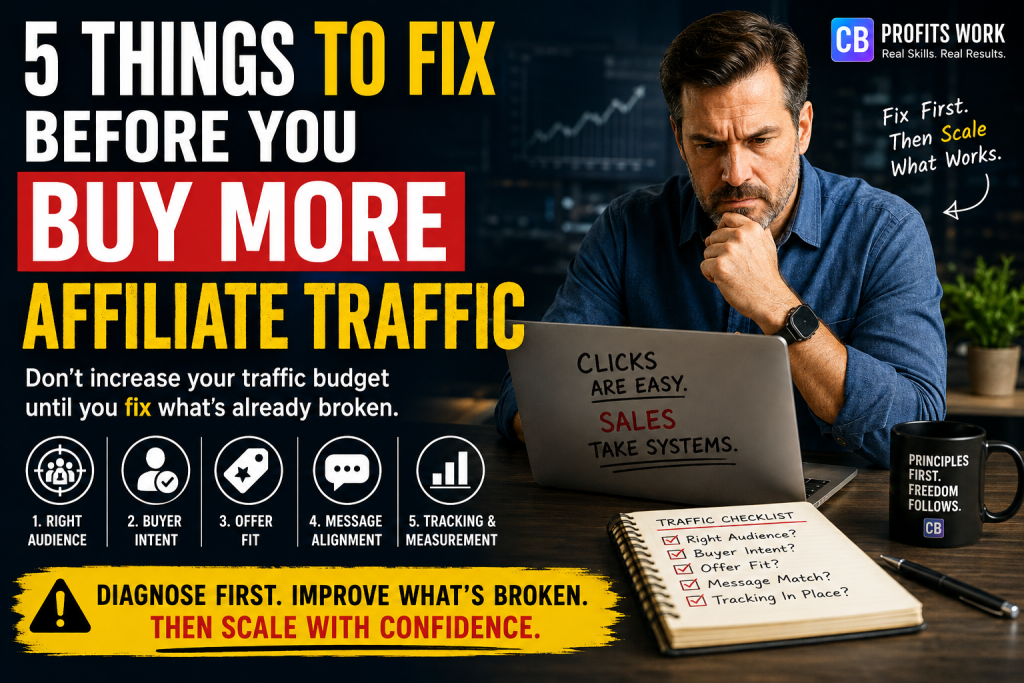

You’re thinking about spending more money to buy more affiliate traffic.
Your reasoning makes sense: more visitors should create more clicks, and more clicks should create more sales.
Sometimes that works.
But sometimes buying more traffic simply sends more people into a process that is already underperforming.
Before you buy more affiliate traffic, determine whether traffic is actually the problem. Check your traffic quality, buyer intent, offer fit, message alignment, and tracking first. If one of those pieces is weak, additional traffic can increase your costs without improving your results.
CBPW Quick Answer: Diagnose before you scale. More traffic can amplify a working affiliate campaign, but it can also amplify the problems in a weak one.
Here are five things I would check before you buy more affiliate traffic.
1. Check Traffic Quality Before You Buy More Affiliate Traffic
More traffic is valuable only when the people arriving have some connection to the problem your affiliate offer solves.
Traffic volume alone can be misleading.
Imagine two campaigns:
- Campaign A sends 2,000 general visitors to an offer.
- Campaign B sends 200 people actively researching the exact problem that offer solves.
Campaign A has ten times more visitors.
But Campaign B may have far greater sales potential because the audience is more relevant.
Before you buy more affiliate traffic, ask:
- Who is currently visiting my content?
- Where is that traffic coming from?
- What problem are those visitors trying to solve?
- Does that problem match the affiliate offer?
- Am I targeting people who could realistically benefit from the product?
If the audience is poorly matched, increasing traffic may only increase the number of irrelevant visitors.
Affiliate Triage™: If your traffic is plentiful but poorly matched, fix the audience before increasing the volume.
2. Check Buyer Intent Before Increasing Traffic
Not every visitor is equally close to buying.
Someone searching for:
“What is affiliate marketing?”
is probably at a different stage than someone searching:
“Best affiliate marketing course for beginners.”
The first person may simply be learning.
The second may already be evaluating solutions.
That difference is buyer intent.
If your traffic consists mainly of people early in the research process, sending them directly to a sales page may be asking for too much too soon.
You may need to help them move through a natural progression:
Problem → Information → Options → Comparison → Decision
Before you buy more affiliate traffic, determine whether the visitors you already have are actually showing buying intent. More visitors at the wrong stage of the buying process may not solve the problem.
If you are already receiving clicks but struggling to generate sales, our guide on why you may be getting affiliate clicks but no sales walks through the broader conversion diagnosis.
3. Make Sure the Affiliate Offer Fits the Audience
A good product does not automatically make a good affiliate offer for every audience.
Before sending additional traffic, take another look at what you are promoting.
Ask:
- Does this product solve a real problem for this audience?
- Is it appropriate for their experience level?
- Is the price reasonable for the people I am targeting?
- Is the product easy to understand?
- Does the merchant have a credible sales process?
- Would I recommend the product if I were not receiving a commission?
If the offer is a poor fit, no amount of additional traffic can completely solve that mismatch.
This is why I would evaluate the offer before deciding to buy more affiliate traffic. If the audience and offer do not fit each other, paying for additional visitors may simply scale the mismatch.
CB Profits Work Principle: Do not send more people to an offer simply because it pays a good commission. Send the right people to solutions that can genuinely help them.
4. Check the Message Before the Click
Your traffic does not arrive without expectations.
The ad, blog post, email, social post, video, or other content that generated the click made some kind of promise.
The page visitors reach afterward needs to make sense in relation to that promise.
For example, imagine your content says:
“A simple way for complete beginners to start affiliate marketing.”
But the visitor clicks through and immediately sees a complicated presentation about advanced funnels, paid advertising, automation, and scaling.
The visitor may leave—not because the product is bad, but because the experience does not match the expectation.
Before you buy more affiliate traffic, compare the message that generates the click with the page visitors see afterward.
Ask whether the transition feels natural.
If it does not, improving that transition may produce better results from the traffic you already have. Fixing message alignment before you buy more affiliate traffic can help you avoid paying to send additional people into the same confusing experience.
5. Make Sure You Can Measure What Happens
This is where many affiliate marketers get into trouble.
They know money is being spent.
They know clicks are happening.
But they cannot clearly identify which traffic source, campaign, piece of content, or audience is generating results.
If you cannot measure performance, spending more money makes troubleshooting harder.
At minimum, try to understand:
- Where the traffic came from
- How many visitors clicked
- Which links or campaigns generated those clicks
- Which traffic sources produced conversions
- What you spent to generate the traffic
- What revenue or commissions resulted
ClickBank recommends tracking traffic sources because doing so can help affiliates see which promotional efforts actually lead to sales. Its tracking tools allow affiliates to distinguish between channels such as blogs, social media, search, and paid campaigns. You can learn more in ClickBank’s guide to traffic sources and traffic types.
This matters even more when using paid traffic.
ClickBank notes that paid advertising can be controllable and scalable, but it can also become expensive and requires active supervision to avoid losing money.
That is why I would not buy more affiliate traffic until I could reasonably tell whether the traffic I already purchased was helping or hurting the campaign.
Why More Affiliate Traffic Does Not Always Mean More Sales
There is an important principle underneath all five of these checks:
Traffic is an amplifier.
If you have a strong audience-to-offer match, clear messaging, reasonable conversion performance, and good tracking, more traffic can help you scale what is working.
If those pieces are weak, more traffic can scale the weakness too.
That is why the decision to buy more affiliate traffic should usually come after diagnosis, not before it.
Before You Buy More Affiliate Traffic, Check These 5 Things
Before spending more money or trying to dramatically increase visitor volume, run through this quick checklist:
- Traffic Quality: Am I attracting the right people?
- Buyer Intent: Are those people actually looking for a solution?
- Offer Fit: Does the product genuinely fit the audience?
- Message Alignment: Does the experience after the click match the promise before it?
- Measurement: Can I tell which traffic sources and campaigns are producing results?
If you cannot confidently answer those questions, you may not need more traffic yet.
You may need better information.
Frequently Asked Questions About Buying Affiliate Traffic
Should I buy more affiliate traffic if I am getting clicks but no sales?
Usually, you should diagnose the existing campaign before increasing your traffic budget. Check whether the visitors are relevant, whether they have buying intent, whether the offer fits them, and whether the message before the click matches what they see afterward. More traffic will not automatically correct a conversion problem.
How do I know if my affiliate traffic is good quality?
Good affiliate traffic generally comes from people whose interests, problems, or buying intent match the offer you are promoting. Instead of judging traffic only by visitor volume, look at engagement, clicks, leads, conversions, and the sources producing those results.
Is paid affiliate traffic better than free traffic?
Neither is automatically better. Paid traffic can provide faster testing and potentially greater scale, while organic traffic can build over time without paying for every visitor. What matters is whether the traffic reaches the right audience and produces results you can measure.
When should I buy more affiliate traffic?
Consider increasing traffic when you understand where your existing visitors come from, the audience fits the offer, your message is aligned with the destination, and your tracking shows that the campaign is producing results worth scaling.
Know What You Are Scaling
There is nothing wrong with wanting more visitors.
Traffic is essential to affiliate marketing, and increasing traffic can be one of the most powerful ways to grow a campaign that already works.
But before you buy more affiliate traffic, understand what you are scaling.
If the audience is right, the offer fits, the message is aligned, and your tracking shows positive results, increasing traffic may make perfect sense.
If those pieces are not working yet, sending more visitors may simply create more expensive confusion.
Diagnose first. Improve what needs improving. Then scale what earns the right to be scaled.
That is the CBPW approach to deciding whether to buy more affiliate traffic: don’t scale because you want more activity. Scale because the evidence tells you the underlying system is ready for more visitors.
For more practical guidance on attracting and evaluating visitors, explore our Traffic articles for affiliate marketers.