
You’re getting affiliate clicks but no sales.
People are finding your content, clicking your links, and reaching the offer.
But the sales still aren’t coming.
The first reaction is often:
“I need more traffic.”
Maybe.
But when you have affiliate clicks but no sales, buying more traffic before you understand the problem can simply make the problem more expensive.
Before changing products, spending more on ads, or rebuilding your funnel, figure out where the process is actually breaking down.
CBPW Quick Answer: Affiliate clicks but no sales usually means you need diagnosis before more traffic. Check traffic quality, buyer intent, audience-to-offer fit, message alignment, trust, the merchant’s sales process, and whether you have enough data before making major changes.
That is where Affiliate Triage™ comes in.
Affiliate Clicks but No Sales? Diagnose Before You Change Anything
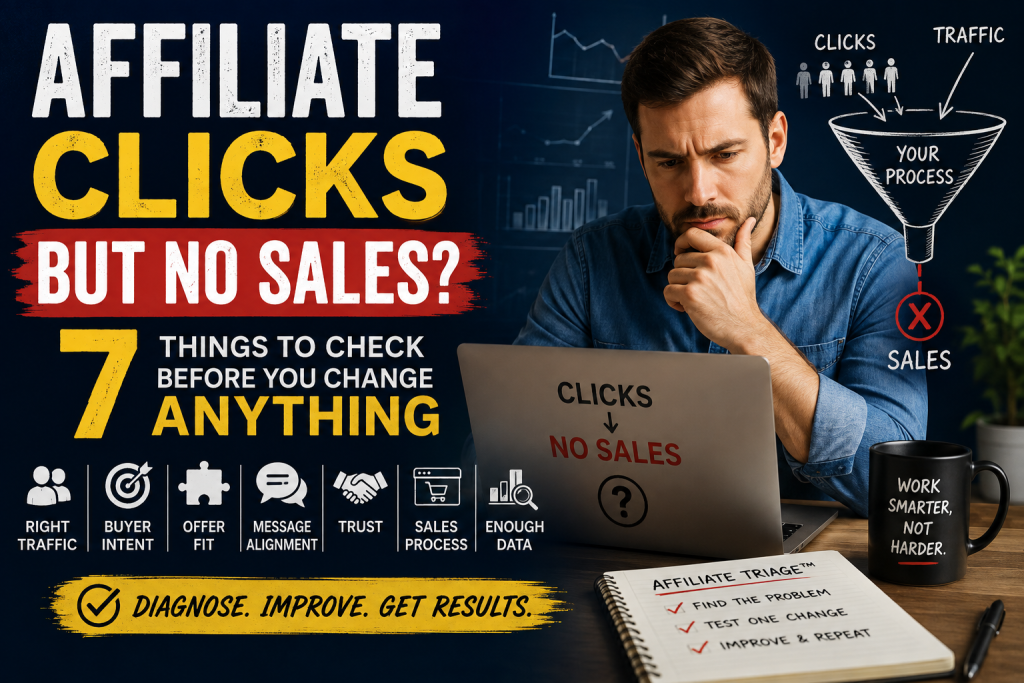
When you have affiliate clicks but no sales, the problem usually falls into one or more of seven areas:
- Traffic quality
- Buyer intent
- Audience-to-offer fit
- Message-to-offer alignment
- Trust
- The merchant’s sales process
- Not enough data
The key is identifying which problem you actually have.
If you change your offer, traffic source, landing page, audience, and call to action all at once, you may improve results without knowing what caused the improvement.
Good affiliate marketing is diagnosis, testing, learning, and improvement.
1. Are You Getting the Right Affiliate Traffic?
Traffic volume and traffic quality are not the same thing.
One hundred visitors actively searching for a solution can be more valuable than 10,000 casual visitors.
Ask yourself:
- Where are my visitors coming from?
- What were they looking for before they found me?
- Does the traffic source fit the audience for this offer?
- Are they researching a problem or simply browsing?
- Am I attracting the people I intended to reach?
If visitors have little interest in solving the problem your offer addresses, more traffic probably won’t improve sales.
When you have affiliate clicks but no sales, weak traffic quality should be one of the first things you investigate.
Affiliate Triage™ Diagnosis: Lots of clicks with weak interest can point to a traffic-quality problem rather than a product problem.
2. Does Your Affiliate Traffic Have Buyer Intent?
Someone can be interested in a topic without being close to buying.
Compare these two searches:
- “What is email marketing?”
- “Best email marketing software for affiliate marketers”
The first visitor may simply be learning. The second may already be comparing solutions.
Both visitors can be valuable, but they are at different stages of the buying process.
If educational content sends a brand-new visitor directly to a sales page, you may be asking them to make a decision before they are ready.
Sometimes the missing step is helping someone move from:
Learning → Understanding → Comparing → Deciding
If you have affiliate clicks but no sales, ask whether those clicks are coming from people who are actually ready to evaluate a solution or from people who are still learning about the problem.
This is one reason understanding your audience is so important in affiliate marketing.
3. Is the Affiliate Offer a Good Match?
A good product can still be wrong for the person you are sending to it.
A high commission does not automatically make an offer worth promoting.
Ask:
- Does this product solve the visitor’s specific problem?
- Is it appropriate for their experience level?
- Is the price realistic for this audience?
- Does it require tools or knowledge they may not have?
- Would I recommend it if there were no commission?
If the answer to that last question is no, think carefully before promoting it.
When you have affiliate clicks but no sales, poor offer-to-audience fit may be the real problem. Sending additional visitors to the same poorly matched offer is unlikely to correct that mismatch.
If you are evaluating ClickBank offers, our guide to choosing ClickBank products using 9 beginner checks can help you examine an offer before sending more traffic to it.
CB Profits Work Principle: Solve the problem first. Recommend what genuinely helps second. Let revenue follow from providing value.
4. Does the Offer Match the Promise Before the Click?
Your blog post, social post, email, video, or ad creates an expectation before the visitor clicks.
If they click expecting one thing and land on a page offering something very different, trust can disappear quickly.
Imagine your content promises a simple beginner solution, but the sales page immediately talks about complicated funnels, automation, advanced advertising, and scaling.
“This isn’t for me.”
The product may be good. The problem may be the transition.
When you see affiliate clicks but no sales, make sure the message before the click matches what the visitor sees afterward.
Your job as an affiliate is not just to generate a click. It is to help the right person understand why the next step makes sense.
CBPW Message-Match Rule: The promise before the click should prepare the visitor for the experience after the click.
5. Have You Built Enough Trust Before the Affiliate Click?
People rarely buy just because an affiliate link appears in front of them.
They buy because they believe the product may help and because they trust the information surrounding the recommendation.
You can build that trust with:
- Useful explanations
- Honest pros and cons
- Personal experience when applicable
- Product demonstrations
- Comparisons with alternatives
- Answers to common objections
- Explaining who a product may not be right for
- Helpful content that does not require a purchase
A useful affiliate review should help someone make a better decision—even if that decision is not to buy.
If you are getting affiliate clicks but no sales, ask whether the visitor has enough reason to trust your recommendation before reaching the merchant.
A click tells you someone was interested enough to continue. It does not necessarily mean you have built enough confidence for that person to purchase.
6. What Happens After the Affiliate Click?
Affiliate marketers usually do not control the entire sales process.
Once someone clicks your link, the merchant may control:
- The sales page
- Pricing
- Checkout
- Guarantees
- Payment options
- Page speed
- Mobile experience
- Follow-up
Good traffic can still produce disappointing results if the merchant’s conversion process is weak.
ClickBank notes that conversion rates can vary based on factors such as traffic source, audience trust, pricing, sales copy, page layout, and seller reputation. You can read more in ClickBank’s guidance on succeeding as an affiliate.
So if you have affiliate clicks but no sales, examine the page you are sending people to.
- Is the offer easy to understand?
- Does the sales page look credible?
- Is the price clearly explained?
- Does the page work well on mobile?
- Does it continue the same message that brought the visitor there?
- Would I personally feel comfortable purchasing from this page?
You may not be able to fix the merchant’s sales page, but you can decide whether that merchant deserves more of your traffic.
7. Do You Have Enough Affiliate Clicks to Judge the Results?
When you have affiliate clicks but no sales, it is tempting to assume something must be broken.
Sometimes you simply do not have enough data yet.
If five people click an affiliate link and nobody buys, that tells you very little.
Even 50 clicks may or may not be enough depending on the offer, traffic source, price, audience, and expected conversion rate.
Instead of saying:
“This offer doesn’t work.”
Ask:
“Do I have enough data to know whether this offer works with this audience and this traffic source?”
Those questions lead to very different decisions.
CBPW Data Rule: A disappointing result is not automatically a reliable conclusion. Make sure you have enough evidence before deciding what the result means.
What Should You Do When You Have Affiliate Clicks but No Sales?
If you have affiliate clicks but no sales, resist the temptation to rebuild everything at once.
Identify the most likely problem and test one meaningful change.
- Keep the offer but test a more relevant traffic source.
- Keep the traffic source but evaluate a better-matched offer.
- Improve the content visitors see before the affiliate link.
- Add a comparison, review, or explanation before sending someone to the merchant.
- Test a clearer call to action.
- Collect more data before changing anything.
If the result improves, you learned something.
If it does not, you still learned something.
If you’re considering spending more money to solve the problem, read 5 things to check before you buy more affiliate traffic first. More traffic makes the most sense when you understand what you are scaling.
Affiliate Triage™ Checklist
Before buying more traffic, changing products, or starting over, ask:
- Traffic: Am I attracting the right people?
- Intent: Are they looking for a solution or simply browsing?
- Fit: Does the product genuinely solve their problem?
- Message: Does the offer match what I promised before the click?
- Trust: Have I given the visitor enough reason to trust the recommendation?
- Merchant: Is the vendor’s sales process helping or hurting conversions?
- Data: Do I have enough evidence to make a decision?
If you do not know which one is broken, do not automatically assume the answer is more traffic.
Affiliate Triage™: Traffic → Intent → Fit → Message → Trust → Merchant → Data
Work through the sequence before making major changes. The goal is not simply to get more clicks. The goal is to understand what those clicks are telling you.
Frequently Asked Questions About Affiliate Clicks but No Sales
Why am I getting affiliate clicks but no sales?
You may be attracting the wrong traffic, reaching visitors without strong buyer intent, promoting an offer that does not fit the audience, creating a mismatch between your message and the merchant’s page, lacking enough trust, sending visitors to a weak sales process, or simply working with too little data to draw a reliable conclusion.
Do affiliate clicks but no sales mean the product is bad?
No. A product can be good and still perform poorly with the wrong audience, traffic source, message, or stage of buyer intent. Diagnose the entire path before concluding that the product itself is the problem.
Should I buy more traffic if I am getting clicks but no sales?
Not automatically. If the existing traffic is poorly targeted or the conversion path is weak, buying more traffic may only increase the cost of the same problem. Determine what is preventing the existing clicks from becoming sales before increasing your traffic budget.
How many affiliate clicks do I need before expecting a sale?
There is no universal number. Results depend on the offer, price, traffic source, audience, buyer intent, merchant conversion process, and other factors. A small number of clicks without a sale may not provide enough evidence to judge an offer accurately.
What should I test first when affiliate links get clicks but no sales?
Start with the most likely weak point rather than changing everything. Check traffic quality and buyer intent first, then examine offer fit, message alignment, trust, the merchant’s page, and the amount of data you have collected.
Affiliate Clicks but No Sales Does Not Always Mean Failure
Traffic matters, but it is only one part of affiliate marketing.
A stronger affiliate business connects the right audience with the right solution, provides useful information, measures what happens, and improves over time.
When you start looking at it that way, affiliate clicks but no sales becomes more than a frustrating result.
It becomes data.
And data gives you something frustration cannot:
A next move based on evidence instead of a guess.
That is the purpose of Affiliate Triage™. Diagnose what is happening, test the most likely problem, learn from the result, and improve the system one decision at a time.
— Bobby Wiggins
CB Profits Work