
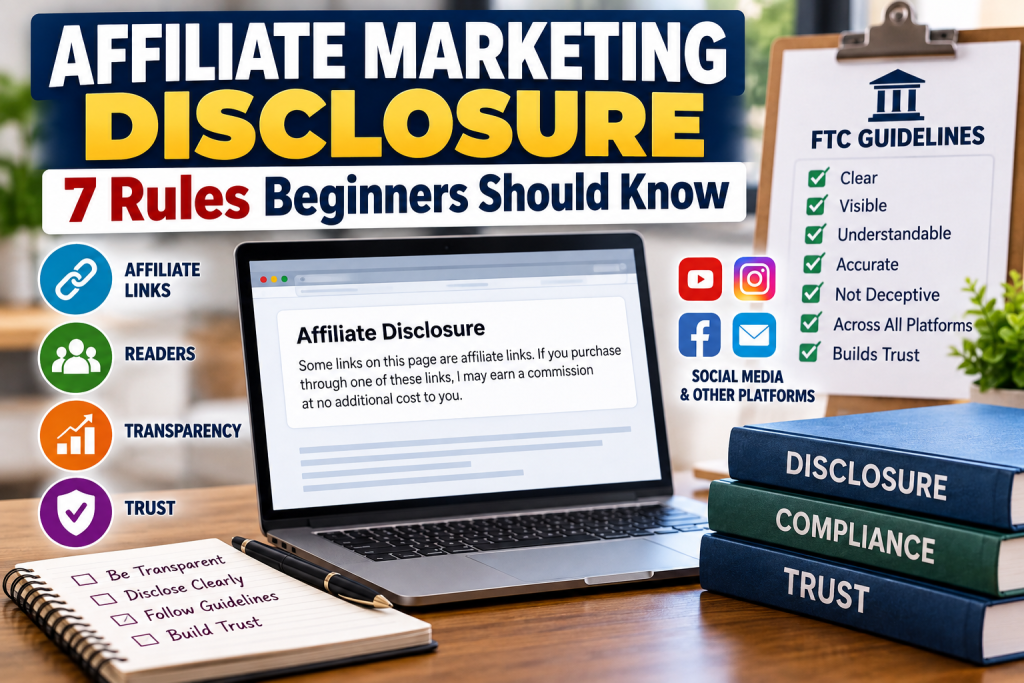

Affiliate Disclosure: Some links on CB Profits Work may be affiliate links. If you purchase through one of these links, I may earn a commission at no additional cost to you. I only recommend tools, products, and resources that I believe may be useful to readers.
An affiliate marketing disclosure tells your audience when you may receive compensation because of a recommendation, endorsement, or affiliate link.
It may seem like a small part of affiliate marketing, but it matters. Readers deserve to understand when you have a financial relationship connected to something you’re recommending.
For beginners, the good news is that disclosure doesn’t have to be complicated. The goal is straightforward: make the relationship clear enough that an ordinary reader can understand it.
Here are seven practical rules to help you approach affiliate disclosures more clearly and consistently.
Affiliate Marketing Disclosure: 7 Essential Rules
1. Clearly Explain the Affiliate Relationship
The basic purpose of an affiliate marketing disclosure is to let people know that you may benefit financially when they use certain links.
You don’t need to bury that explanation in complicated legal language.
For example, a straightforward disclosure might say:
Affiliate Disclosure: Some links on this page are affiliate links. If you purchase through one of these links, I may earn a commission at no additional cost to you.
That tells the reader what the relationship is and how you may benefit.
The Federal Trade Commission provides guidance about endorsements and material connections between endorsers and marketers. You can review the FTC’s endorsement guidance for more information.
2. Put the Disclosure Where People Can See It
A disclosure isn’t very helpful if readers are unlikely to notice it.
That’s why placement matters.
If an article contains affiliate recommendations, placing a clear disclosure near the beginning of the content can help readers understand the relationship before encountering promotional links.
An affiliate marketing disclosure shouldn’t depend on someone finding a separate disclosure page hidden in the footer of your website.
A site-wide disclosure or policy page can still be useful, but it doesn’t necessarily replace a clear disclosure associated with the content containing the endorsement or affiliate relationship.
3. Use Language People Can Understand
Readers shouldn’t need a law degree to figure out whether you may earn money from a recommendation.
Simple phrases such as “I may earn a commission” or “this post contains affiliate links” communicate the relationship much more clearly than vague wording.
Be cautious about relying only on terms that an average visitor may not understand.
The purpose of an affiliate marketing disclosure isn’t simply to have some words somewhere on the page. The purpose is to communicate meaningful information to the reader.
4. Disclose Affiliate Relationships on Social Media Too
Affiliate disclosure isn’t limited to blog posts.
If you’re promoting affiliate products through social media, video, email, or other channels, consider how the relationship will be communicated clearly in that particular format.
For example, a disclosure buried behind several clicks or placed somewhere people are unlikely to notice may not communicate the relationship effectively.
This is particularly important for anyone doing affiliate marketing without a website, because much of the promotional activity may take place on third-party platforms rather than a traditional blog.
Each platform may also have its own rules regarding branded content, paid partnerships, advertising, and affiliate promotions. Check the current requirements of the platform you’re using.
5. Don’t Let a Disclosure Become an Excuse for Exaggerated Claims
An affiliate marketing disclosure tells people about the financial relationship. It doesn’t make unsupported marketing claims acceptable.
If you’re recommending a product, your statements about that product should still be accurate and supportable.
That means avoiding exaggerated promises simply because a disclosure appears at the top of the page.
This is also why we emphasize helpful, reader-focused affiliate content that gets clicks without sounding salesy. Trust is more valuable than squeezing an extra click out of exaggerated copy.
6. Don’t Hide the Disclosure Inside Your Terms or Privacy Policy
Having legal and policy pages on a website is important, but readers shouldn’t have to search through them to discover that a recommendation may result in compensation.
If a particular article contains affiliate links, make the relationship clear in connection with that content.
You can still maintain a more detailed affiliate disclosure page explaining your site’s broader policies.
Think of the site-wide page as additional information—not as a reason to hide the disclosure somewhere away from the recommendation itself.
7. Make Disclosure Part of Your Publishing Process
The easiest way to forget disclosures is to treat them as something you’ll remember to add later.
Instead, make your affiliate marketing disclosure part of your normal publishing checklist.
Before publishing affiliate content, ask:
- Does this content contain affiliate links?
- Is the affiliate relationship clearly explained?
- Is the disclosure easy to notice?
- Is the language understandable?
- Are product claims accurate and supportable?
- Does the affiliate program have additional disclosure requirements?
- Does the platform I’m publishing on have its own rules?
Making disclosure part of the workflow is easier than trying to audit dozens of articles later.
Why Affiliate Marketing Disclosure Builds Trust
Some beginners worry that telling readers about an affiliate relationship will discourage clicks.
That’s the wrong way to think about it.
A clear affiliate marketing disclosure gives readers information they deserve to have before deciding whether to act on a recommendation.
It also establishes an important expectation: you’re willing to tell your audience when you have a financial interest connected to a recommendation.
That’s consistent with the larger approach we use at CB Profits Work.
Education first. Explain the opportunity. Disclose the relationship. Let the reader decide.
Affiliate Disclosure and Product Reviews
Disclosure becomes especially important when you’re reviewing or recommending products.
If you may receive compensation when someone purchases the product you’re discussing, readers should be able to understand that relationship.
That doesn’t mean an affiliate review can’t be useful or credible.
It means the review should stand on the usefulness and accuracy of the information—not on hiding how the publisher may be compensated.
When selecting products to promote, our guide on how to choose ClickBank products explains several checks beginners can make before deciding what belongs in their business.
Affiliate Disclosure and Link Tracking Are Different
It’s also important not to confuse disclosure with tracking.
Tracking tells you where clicks and conversions came from. Disclosure tells your audience about your financial relationship.
You need to think about both.
Our guide on how to track affiliate links explains seven metrics beginners can use to better understand campaign performance.
Tracking can help you improve your marketing decisions, while an affiliate marketing disclosure helps readers understand when you may benefit from their decision.
Create a Simple Affiliate Disclosure Standard
If you’re building an affiliate marketing business, create a simple disclosure standard you can apply consistently.
For example, your process might include:
- A clear disclosure near the beginning of affiliate articles
- Appropriate disclosures in emails containing affiliate promotions
- Clear disclosure when recommending products through social content
- A dedicated affiliate disclosure page for additional information
- Regular checks of affiliate-network and platform requirements
This gives you a repeatable process rather than reinventing your disclosure language every time you publish something.
As your business grows, you can review and update that process when regulations, platforms, or affiliate-program requirements change.
The CB Profits Work Takeaway
An affiliate marketing disclosure shouldn’t be treated as an annoying sentence you add because somebody told you that you have to.
It’s part of building a transparent relationship with your audience.
Tell readers when you may earn a commission. Put the disclosure where they can reasonably see it. Use understandable language. Apply the same principle across your website, email, social media, video, and other affiliate channels.
And remember that disclosure doesn’t replace responsible marketing.
Recommend carefully. Make supportable claims. Disclose the relationship. Let the reader make the decision.
Free: Affiliate Marketing Foundation Checklist
Disclosure is only one part of building a solid affiliate marketing foundation.
The free CB Profits Work 40-Point Affiliate Marketing Foundation Checklist gives you a practical way to review your audience, content, traffic, offers, tracking, disclosures, and other essential parts of your affiliate marketing business.
→ Get the Free 40-Point Affiliate Marketing Foundation Checklist