
Promoting affiliate products can look deceptively simple when you’re new to affiliate marketing.
Find a product. Get an affiliate link. Share the link. Earn a commission.
Technically, you can begin that way. But if you want to build something that has a realistic chance of producing consistent results, there are several things you should put in place before you start promoting affiliate products.
At CB Profits Work, I call this the Foundation-First Approach:
Don’t start with the affiliate link. Start by building the path that gives the link a job to do.
That means knowing who you’re trying to help, understanding their problem, choosing an appropriate offer, creating useful content, having a way to continue the relationship, and measuring what happens.
When you’re promoting affiliate products, these pieces help turn individual recommendations into a more organized affiliate marketing system.
Here are seven things I believe every beginning affiliate marketer should have in place.
What Should You Have in Place Before Promoting Affiliate Products?
Before promoting affiliate products, a beginner should ideally have seven basic pieces in place:
- A clearly defined audience
- A specific problem to help solve
- A relevant affiliate offer
- A useful reason for someone to listen to you
- A path from content to the offer
- A way to follow up with interested prospects
- A simple method for tracking results
You don’t need a huge website, thousands of followers, expensive software, or a complicated sales funnel.
You do need a foundation.
Let’s look at each part.
1. Know Who You Want to Help
One of the easiest mistakes to make in affiliate marketing is trying to promote to everybody.
If your audience is “anyone who wants to make money,” it becomes difficult to decide what content to create, what problems to discuss, and what products to recommend.
That’s especially important when promoting affiliate products because a product that fits one audience may be completely wrong for another.
Get more specific.
Too broad: People who want to make money online.
Better: Beginners who want to learn affiliate marketing.
More focused: Adults starting affiliate marketing who are overwhelmed by the technology and don’t know what to do first.
The clearer you become about the person you’re helping, the easier the next six steps become.
CBPW Quick Check
Can you complete this sentence?
I help __________ who want to __________.
If you can’t answer it yet, don’t worry about finding another product.
Work on the audience first.
2. Identify the Problem Before Choosing the Product
Beginners often do this backward.
They discover a product with an attractive commission and then try to figure out who might buy it.
Try reversing that process.
Person → Problem → Solution → Product
Start with your audience.
What are they struggling with?
What are they trying to accomplish?
What is preventing them from getting there?
Then determine whether a particular product genuinely helps solve that problem.
This creates a very different kind of affiliate business. Instead of promoting affiliate products simply because they offer attractive commissions, you’re connecting relevant solutions to problems your audience actually has.
Instead of asking:
“How can I sell this product?”
you begin asking:
“Would this product actually help the person I’m trying to serve?”
That’s a much better question.
3. Evaluate the Offer Before You Recommend It
A high commission does not automatically make something a good affiliate offer.
Before recommending a product, investigate it. If you’re evaluating offers from ClickBank, my 9 beginner checks for choosing ClickBank products will give you a practical starting point.
Promoting affiliate products responsibly starts with understanding what you are recommending and who it is designed to help.
Look at things such as:
- What problem does the product solve?
- Who is the product actually designed for?
- Is the sales page clear about what buyers receive?
- Is the pricing reasonable for the value provided?
- Is there adequate customer support?
- Does the product make exaggerated or unrealistic claims?
- Would you feel comfortable recommending it to someone you know?
Whenever possible, actually use the product yourself.
Firsthand experience gives you something extremely valuable: the ability to explain what you liked, what you didn’t like, who you think it fits, and who probably shouldn’t buy it.
That is far more useful than repeating the vendor’s sales page, especially when you’re promoting affiliate products to an audience that depends on you for useful guidance.
4. Give People a Reason to Listen Before Asking Them to Buy
Affiliate marketing works better when promotion is connected to useful information.
That information might be:
- A tutorial
- A product comparison
- A checklist
- A demonstration
- A case study
- A beginner’s guide
- A problem-solving article
- A video showing how something works
The purpose isn’t to hide the fact that you’re an affiliate.
It’s exactly the opposite.
Be useful and transparent.
When you receive compensation if someone purchases through your link, disclose that relationship clearly. Don’t bury it where visitors are unlikely to see it. The FTC’s endorsement guidance explains how marketers should clearly disclose material connections and affiliate relationships.
Transparency should be part of promoting affiliate products, not something added only after a visitor reaches the purchase decision.
Your goal should be simple:
Help first. Recommend second.
5. Build a Path Instead of Dropping an Affiliate Link
Imagine someone sees one of your Facebook posts.
They become interested.
What happens next?
If the entire strategy is:
Facebook post → affiliate link
you’re relying on that person to make a purchasing decision immediately.
Instead, think about the journey.
Promoting affiliate products works better when each recommendation fits naturally into a helpful path for the reader.
A simple affiliate path might look like this:
Helpful Content → Useful Resource → Email Follow-Up → Relevant Recommendation
Or:
Search Question → Helpful Article → Product Review → Affiliate Offer
The path doesn’t need to be complicated.
It simply needs to make sense.
Every step should naturally help the visitor decide what to do next.
The CBPW Foundation-First Rule
Every link should have a purpose, and every step should prepare the visitor for the next one.
Don’t add technology simply because another marketer says you need it.
Build the simplest path that accomplishes the job.
6. Have a Way to Continue the Conversation
Most people who discover your content won’t buy something immediately.
That’s normal.
This is why an email list can become one of the most valuable assets in an affiliate business.
Instead of hoping someone remembers your website or Facebook page, you can invite interested visitors to receive something useful.
That might be:
- A checklist
- A short guide
- A mini-course
- A resource list
- A template
- A helpful email series
Then continue helping them.
Notice the emphasis:
continue helping them.
An email list shouldn’t become an excuse to send affiliate offers every day.
When promoting affiliate products through email, follow-up should continue the same helpful relationship that encouraged someone to subscribe in the first place.
Use follow-up to answer questions, teach useful concepts, share your experience, and occasionally recommend products that fit what your subscribers are trying to accomplish.
7. Decide What You’re Going to Measure
You can’t improve what you never measure.
Fortunately, beginners don’t need an enormous analytics dashboard.
Start with a few simple numbers.
Track:
Visitors → Leads → Clicks → Sales
For example, suppose 500 people visit an article.
50 join your email list.
20 click through to the product.
2 purchase.
Now you have information.
Maybe the article attracts visitors but doesn’t generate subscribers.
Maybe people subscribe but don’t click your recommendation.
Maybe plenty of people click but nobody buys.
Those are three completely different problems.
This is why tracking matters when promoting affiliate products. It helps you determine whether the problem is your traffic, your message, your path, your offer, or something else.
Without tracking, they can all feel like:
“Affiliate marketing isn’t working.”
Tracking helps you identify where the actual problem is.
What Do You NOT Need Before Starting Affiliate Marketing?
This is equally important.
You don’t need everything figured out.
You don’t necessarily need:
- Thousands of social media followers
- An expensive funnel builder
- Ten affiliate products
- Complicated automation
- Paid advertising
- A giant email list
- Perfect branding
Those things may become useful later.
But adding more tools to a weak foundation usually creates a more complicated weak foundation.
You can begin promoting affiliate products without an elaborate technology stack, provided you understand your audience, your offer, and the path you want visitors to follow.
Start simple.
Build the foundation.
Then improve the system as you learn.
The CBPW Foundation-First Approach
If you remember nothing else from this article, remember this:
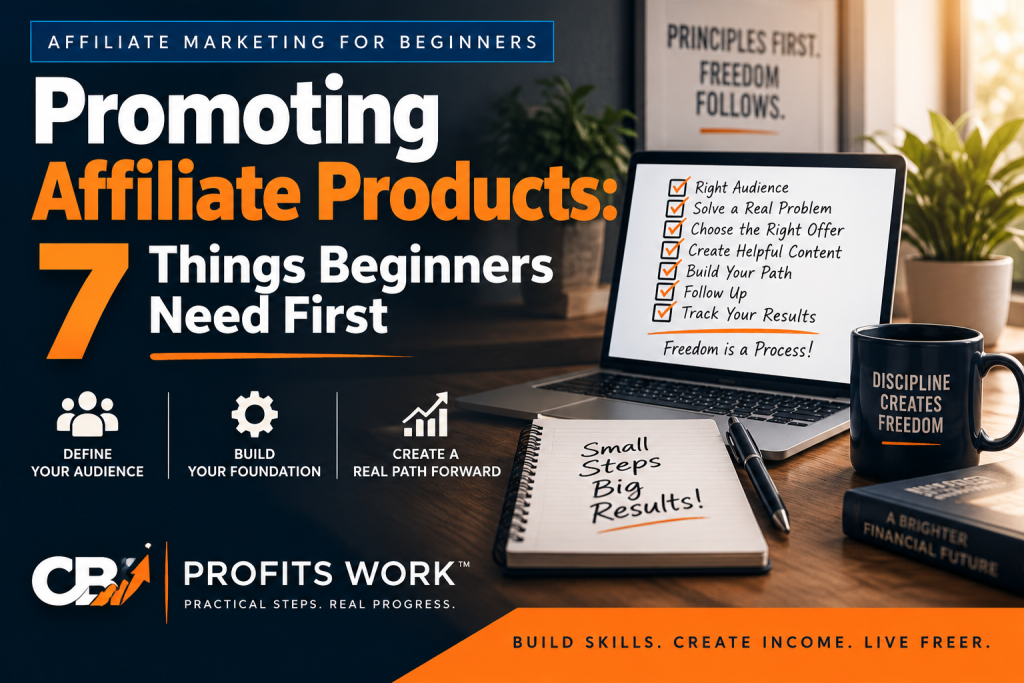
Audience → Problem → Offer → Content → Path → Follow-Up → Measurement
That’s the foundation.
Notice where the affiliate product appears.
It isn’t first.
That’s intentional.
Affiliate marketing shouldn’t begin with finding something to sell.
It should begin with identifying someone you can help.
Once those seven pieces start working together, you’re no longer randomly sharing affiliate links.
You’re beginning to build an affiliate marketing system.
The goal of promoting affiliate products should not be to share more links, but to make better recommendations within a stronger system.
Frequently Asked Questions
Can I start affiliate marketing without a website?
Yes. Affiliate marketing can be done through several channels, including social media, email, video, and other platforms that permit affiliate promotion. However, owning a website gives you an asset you control and a central place for your content, resources, reviews, and email capture.
Do I need an email list before promoting affiliate products?
You don’t have to have an email list before making your first recommendation. However, building one early gives you a way to continue communicating with people who are interested but aren’t ready to purchase immediately. That follow-up can make promoting affiliate products less dependent on getting an immediate sale from a first-time visitor.
How many affiliate products should a beginner promote?
There isn’t a perfect number, but beginners usually benefit from focusing on a small number of carefully selected offers rather than constantly jumping between products. Learn the audience, problem, and product well before expanding.
Should beginners use paid advertising for affiliate marketing?
Paid advertising can generate traffic quickly, but it also creates the possibility of losing money quickly. Beginners should understand their offer, conversion path, tracking, and the advertising platform’s rules before spending heavily on ads.
Should I promote an affiliate product I haven’t personally used?
It’s possible, but firsthand experience makes it easier to provide an original and credible recommendation. If you haven’t personally used a product, be transparent about that and don’t imply experience you don’t have. When promoting affiliate products you haven’t personally tested, be especially careful to distinguish what you know from what the vendor claims.
How long does affiliate marketing take to work?
There is no reliable universal timeline. Results depend on factors including your audience, offer, content, traffic, follow-up, conversion rates, consistency, and experience. Be cautious of anyone promising guaranteed income within a specific number of days.
Start With Your Foundation
If you’re new to affiliate marketing, resist the pressure to do everything at once.
You don’t need another dozen tools.
You don’t need another dozen products.
And you certainly don’t need another dozen affiliate links.
You need to know whether the basic pieces of your business are actually in place.
That’s exactly why I created the Affiliate Marketing Foundation Checklist.
It will help you examine the foundational pieces of your affiliate marketing setup and identify where you may have gaps before you spend more time or money promoting affiliate products.
Ready to check your affiliate marketing foundation?
Get Your Free Affiliate Marketing Foundation Checklist →
Build the foundation first.
Then build on it.
— Bobby Wiggins
CB Profits Work