

Affiliate disclosure: This post contains paid affiliate links. If you purchase through one of these links, I may earn a commission at no additional cost to you. Read my full Affiliate Disclosure.
Learning how to choose ClickBank products is one of the first important decisions a new affiliate marketer has to make.
The ClickBank Marketplace contains thousands of offers, and it is easy to be attracted by a high commission, strong Gravity score, or impressive sales page.
But none of those things automatically mean a product is right for your audience—or right for you to promote.
If you are learning how to choose ClickBank products, a better approach is to evaluate the entire opportunity: the audience, problem, product, vendor, sales process, commission structure, promotional restrictions, content potential, and your ability to test the offer responsibly.
CBPW Quick Answer: Choose ClickBank products based on audience fit and product quality first, then evaluate the vendor, sales process, Marketplace statistics, commissions, compliance requirements, promotional resources, content potential, and testability before committing significant time or money.
That gives you a much stronger basis for deciding what deserves further research.
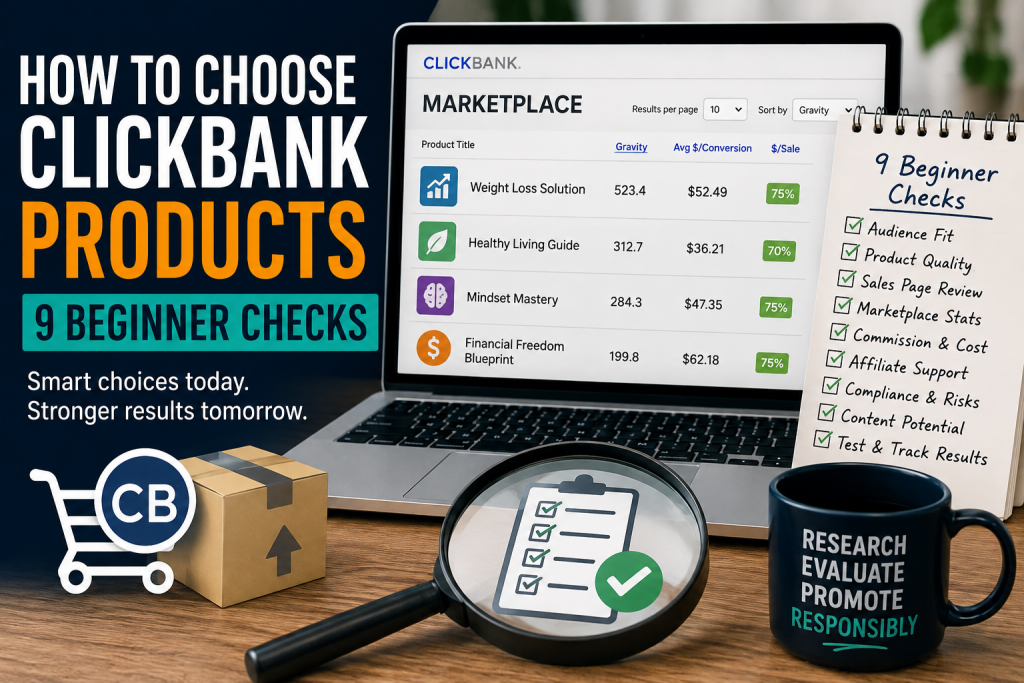
How to Choose ClickBank Products: The CBPW 9-Point Offer Filter™
I use a simple principle when evaluating affiliate offers:
Do not start with the commission. Start with the customer.
The CBPW 9-Point Offer Filter™ looks at nine areas:
- Audience fit
- Product and vendor quality
- Sales-process quality
- Marketplace statistics
- Commission economics
- Affiliate support
- Advertising and compliance risk
- Content potential
- Testability and tracking
When learning how to choose ClickBank products, these nine checks can help you move beyond choosing offers based on hype or commission size alone.
1. Begin With the Audience, Not the Commission
It is tempting to open the ClickBank Marketplace, sort offers by potential earnings, and focus immediately on whichever product appears to pay the most.
That puts the commission ahead of the customer.
A better starting point is identifying the audience you want to help and the problem they are trying to solve.
Ask:
- Who is the intended customer?
- What specific problem does the product address?
- How important is that problem to the customer?
- Is the customer actively looking for a solution?
- Can I create useful content for this audience?
- Would I feel comfortable discussing this product with someone I know?
A product that fits a clearly defined audience gives you more opportunities to create relevant articles, emails, videos, checklists, comparisons, and advertisements.
If you cannot clearly identify the audience or explain why the offer may help them, the product probably should not become one of your first promotions.
Learning how to choose ClickBank products starts with serving the right people—not chasing the largest number displayed in the Marketplace.
CBPW Audience-First Rule: If you cannot explain who the product helps and what problem it solves, you are not ready to promote it.
2. Investigate the Product and Vendor
The next check is the product itself.
An affiliate recommendation can affect the trust a reader places in your website, emails, and future recommendations, so you need more than a sales page before forming an opinion.
Whenever possible, examine the actual product instead of relying solely on the vendor’s marketing materials. ClickBank recommends contacting sellers when appropriate to request access for promotional evaluation.
Your research may include:
- The product’s contents and delivery method
- The vendor’s experience and reputation
- Available customer support
- Current pricing and billing terms
- The refund or cancellation policy
- Whether the product is updated when necessary
- Whether the product delivers what its sales page describes
A vendor may decline to provide review access, and that does not automatically mean the offer is unsuitable.
However, you should still gather enough reliable information to describe the product accurately.
Do not invent personal results, imply that you used a product when you did not, or repeat vendor claims that you cannot support.
That is an important part of how to choose ClickBank products responsibly.
3. Review the Entire Sales Process
A product may appear useful while its sales process creates concerns.
Follow the customer’s journey from the first sales page through the order process.
Review:
- The clarity of the main promise
- Whether claims appear reasonable and properly explained
- How prominently pricing and billing details are displayed
- Whether recurring charges are clearly disclosed
- How the page displays on a mobile device
- Whether the checkout process feels trustworthy
- How upsells or additional offers are presented
Your advertisement, article, email, or bridge page may introduce someone to the offer, but the vendor’s sales process still has to complete the sale.
A confusing, overly aggressive, or poorly matched sales page can undo much of the trust you worked to establish before the click.
The vendor controls that page, which means it can also change.
That is why product pages and promotional materials should be reviewed periodically rather than evaluated once and forgotten.
If you are deciding how to choose ClickBank products, do not judge only the product. Judge the customer experience surrounding the product too.
4. Understand ClickBank Marketplace Statistics
ClickBank provides Marketplace statistics that can help affiliates compare offers.
Depending on the listing and current reporting system, useful measurements may include:
- Gravity: an approximate measure reflecting recent affiliate sales activity
- Average dollars per conversion: average affiliate earnings associated with a conversion
- Initial dollars per conversion: average initial affiliate earnings before future rebills
- Future dollars per conversion: average affiliate earnings from applicable recurring payments
- Earnings per click: average commission generated per affiliate click during the reporting period
- Conversion rate: the percentage of affiliate clicks that produce an initial sale during the reporting period
You can learn more from ClickBank’s official guide to using Marketplace statistics.
These numbers can be useful, but they are not guarantees.
A high Gravity score may indicate that affiliates are generating sales, but it can also signal greater competition.
A lower score might identify a less competitive opportunity—or it may indicate limited demand or weaker performance.
When learning how to choose ClickBank products, use Marketplace statistics as clues for further research rather than treating one number as the final answer.
CBPW Marketplace Rule: Use the numbers to decide what deserves investigation—not what deserves automatic promotion.
5. Examine the Commission Structure and Customer Cost
Commission information matters because a campaign needs a reasonable opportunity to recover its expenses.
But the advertised commission percentage does not tell the whole story.
Consider:
- The product’s actual purchase price
- The initial commission amount
- Whether the offer includes order bumps or upsells
- Whether recurring commissions are available
- Potential refund or cancellation activity
- Payment-processing deductions
- The expected cost of content, software, email services, or advertising
A higher-priced product with a substantial commission may be harder to convert.
A lower-priced product may convert more easily but require more sales to cover campaign expenses.
Neither structure is automatically better.
The right choice depends on the audience, offer, traffic source, and entire customer journey.
When deciding how to choose ClickBank products, look beyond the commission percentage and ask whether the economics of the offer make sense for the campaign you intend to build.
Never spend money required for essential expenses based on anticipated affiliate commissions. Affiliate income is uncertain, and campaign costs can exceed earnings.
6. Look for Affiliate Support and Promotional Resources
Some vendors provide affiliate tools pages containing approved images, product information, email ideas, keywords, demographic information, and advertising guidance.
These resources can save time and help you understand how the vendor expects the product to be promoted.
Check whether the vendor provides:
- Current product details
- Approved images and branding
- Guidance about prohibited claims
- Traffic-source restrictions
- Affiliate contact information
- Tracking or reporting instructions
- Notice when important offer details change
Vendor resources should be treated as research material, not content to copy blindly.
Good affiliate support can make it easier to represent the product accurately, but the affiliate remains responsible for reviewing promotional content and following the requirements of the advertising and email platforms being used.
This makes vendor support another useful factor when evaluating how to choose ClickBank products.
7. Evaluate Advertising and Compliance Risks
A product that can be promoted through one traffic source may be restricted on another.
Advertising platforms maintain their own policies, and those policies can change.
Before building a campaign, investigate:
- Whether the product category is allowed by the intended advertising platform
- Whether the vendor restricts brand-name bidding or particular traffic sources
- Whether the sales page contains claims that could create advertising problems
- Whether age, geographic, or audience restrictions apply
- Which affiliate and earnings disclosures are needed
- Whether your landing page explains the offer accurately
Health, financial, employment, and income-related offers may require particularly careful evaluation because exaggerated or unsupported claims can create consumer and advertising risks.
The Federal Trade Commission also expects affiliate relationships to be disclosed clearly and conspicuously. Its endorsement guidance provides additional information about disclosures and endorsements.
A high commission does not compensate for a product you cannot promote responsibly or consistently.
So when deciding how to choose ClickBank products, compliance risk should be part of the decision before you invest money in traffic or build a campaign around the offer.
8. Determine Whether You Can Build Useful Content Around the Product
This is one of the most overlooked parts of how to choose ClickBank products.
Ask whether the offer gives you enough opportunities to educate the audience before asking for a purchase.
Useful content might include:
- Beginner guides
- Frequently asked questions
- Product comparisons
- Checklists and worksheets
- Common mistakes
- Readiness assessments
- Implementation plans
- Honest reviews
- Product demonstrations when available
If you cannot think of useful content that helps someone understand the problem, compare options, or make a better decision, the product may not fit your overall content strategy.
A useful lead magnet should solve a small, relevant problem on its own. It should not simply repeat the vendor’s sales page or hide an affiliate link behind an email form.
After receiving the resource, subscribers can move through a transparent path that explains the next step before sending them to a merchant through a properly disclosed affiliate link.
This fits the broader CB Profits Work approach:
Help first. Recommend second.
Before you begin promoting affiliate products, the product should fit into a useful path that makes sense for the audience.
9. Test Small and Track the Complete Journey
Understanding how to choose ClickBank products involves research, but no amount of Marketplace data can predict campaign performance with certainty.
Eventually, an offer has to face real visitors.
Start with a limited test and a clearly defined objective.
Track the journey from the original traffic source through the landing page and affiliate link.
Useful measurements may include:
- Advertisement impressions and clicks
- Landing-page visits
- Lead-capture conversions
- Bridge-page clicks
- ClickBank HopLink activity
- Email opens and clicks
- Initial sales and refunds
- Total campaign costs compared with commissions received
A campaign that does not produce a sale immediately is not automatically worthless.
It may reveal a weak advertisement, incorrect audience, confusing landing page, unsuitable product, or tracking problem.
If you are receiving affiliate clicks but no sales, diagnose the full conversion path before assuming the product itself is the problem.
And before spending more money, review the five things to check before you buy more affiliate traffic.
Change one major variable at a time whenever possible.
Otherwise, you may not know which change improved or damaged the results.
CBPW Testing Rule: Research narrows the choices. Testing tells you what actually happens.
How I Plan to Choose ClickBank Products
My approach to how to choose ClickBank products is to begin with a larger group of possible offers, evaluate them using consistent standards, and narrow the list to the strongest candidates.
Rather than immediately putting the most promising offer into a full campaign, I can use a secondary candidate as a pilot.
The pilot allows the traffic, lead-capture, email, bridge-page, affiliate-link, and tracking process to be tested before committing more resources to the strongest candidate.
Useful signals may include:
- Qualified leads
- Email engagement
- Bridge-page clicks
- HopLink activity
- Sales
- Refund activity
- Campaign cost
High volumes of inexpensive traffic do not automatically mean a campaign is working.
The goal is to learn whether the complete system is attracting the right people and moving them toward the right solution.
This process cannot guarantee success.
But it can provide a more disciplined basis for deciding what to test, improve, continue, or stop.
The CBPW 9-Point Offer Filter™ Checklist
Before deciding that an offer deserves serious promotion, ask:
- Audience: Does the product solve a real problem for people I can reach?
- Product: Can I gather enough reliable information to discuss it honestly?
- Sales Process: Would I feel comfortable sending someone through the vendor’s buying experience?
- Marketplace Data: Do the statistics justify further research without becoming the entire decision?
- Economics: Does the commission structure make sense relative to the customer cost and campaign expenses?
- Support: Does the vendor provide useful affiliate information and promotional guidance?
- Compliance: Can I promote the product responsibly through the channels I intend to use?
- Content: Can I create genuinely helpful material around the problem and solution?
- Testing: Can I test the offer on a controlled scale and measure the complete journey?
Audience → Product → Sales Process → Data → Economics → Support → Compliance → Content → Testing
That is the CBPW framework I want guiding how to choose ClickBank products.
Frequently Asked Questions About How to Choose ClickBank Products
What should beginners look for when choosing a ClickBank product?
Beginners should start with audience fit and product quality, then evaluate the vendor, sales process, Marketplace statistics, commissions, promotional resources, compliance requirements, content potential, and whether the offer can be tested and tracked responsibly.
Is ClickBank Gravity the best way to choose a product?
No. Gravity can provide useful information about recent affiliate activity, but it should not be the only factor used to choose an offer. A product still needs to fit your audience, solve a relevant problem, and make sense within your promotional strategy.
Should I choose the ClickBank product with the highest commission?
Not automatically. A high commission does not guarantee strong conversions, a good customer experience, or an appropriate fit for your audience. The complete campaign economics matter more than the advertised percentage alone.
How many ClickBank products should a beginner promote?
There is no single number that fits everyone. For a beginner, focusing on a small number of carefully researched offers can make it easier to understand the audience, create useful content, track performance, and learn from the results.
How do I know whether a ClickBank product is worth testing?
A product may be worth testing when it solves a clear audience problem, comes from a vendor you can evaluate, has a credible sales process, can be promoted within platform rules, supports useful content, and offers enough potential to justify a controlled test.
What is the biggest mistake beginners make when choosing ClickBank products?
One common mistake is choosing an offer primarily because of the commission or Marketplace statistics instead of first asking whether the product genuinely fits the audience they want to serve.
Final Thoughts on How to Choose ClickBank Products
Learning how to choose ClickBank products requires more than finding a popular offer.
The strongest candidate should fit the audience, solve a genuine problem, come from a vendor you can reasonably evaluate, support responsible promotion, and provide enough campaign potential to justify testing.
Marketplace statistics can help.
So can commission information.
But neither replaces judgment.
The goal is not to find the product with the biggest numbers. The goal is to find a product that earns the right to be tested.
That distinction matters.
Choosing carefully helps you create better content, make more responsible recommendations, and spend your testing budget with greater purpose.
That is the approach I intend to keep using as I learn how to choose ClickBank products and document the process through CB Profits Work.
Purchasing training, using affiliate tools, or selecting a popular product does not guarantee traffic, commissions, profit, or any other result.
Review every offer independently and make decisions that fit your goals, budget, experience, and tolerance for risk.
For additional information about how this website discusses affiliate products and potential results, read the CB Profits Work Earnings Disclaimer and Affiliate Disclosure.
— Bobby Wiggins
CB Profits Work